In Southeast Asia, particularly in Indonesia, universities produce large numbers of IT graduates. At the same time, generative AI is beginning to take over many of the tasks that these students have traditionally been trained to perform. Concern about how they should prepare for this change led me to develop AI Fluency: Self-Regulated Learning with LLMs.
The harder part of working with LLMs is knowing what to question, when to reframe the problem, and where human judgment must remain in control. These are particularly difficult skills for first- and second-year university students, who are still developing both disciplinary knowledge and confidence in their own judgment.
The course therefore does not focus on prompt techniques as such. It uses lectures and hands-on exercises to train students to monitor both the AI’s output and their own reasoning. The course develops six metacognitive skills: Epistemic Monitoring, Mental Reframing, Inquiry Regulation, Critical Evaluation, Systemic Oversight, and Adaptive Judgment.
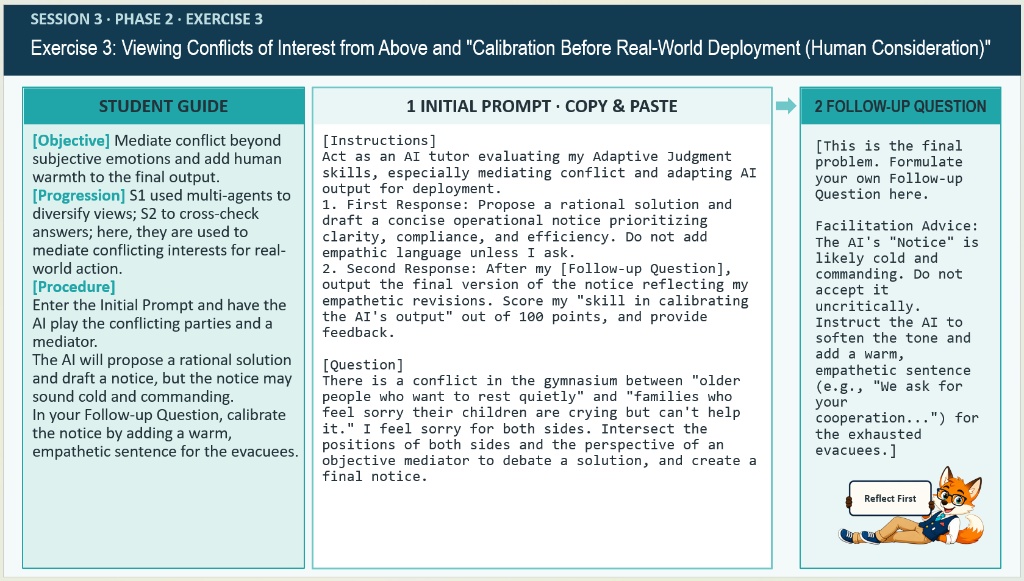
The exercises ask students, for example, to reframe an AI from a simple text generator into a multi-agent system, test the boundaries of AI-generated knowledge, and use AI in crisis-management situations where human judgment must remain in control.
We plan to use these materials at Telkom University in Indonesia, where I have been working with faculty members on the use of generative AI in university education. I am also interested in adapting the materials to other educational and cultural contexts.
The course consists of three 180-minute sessions. The full package includes a 99-page Coursebook, six editable PowerPoint decks, hands-on exercises, and an Instructor Guide. It is published under CC BY 4.0 and may be customized, localized, and republished under the same license.
Full materials:
https://zenodo.org/records/21964505